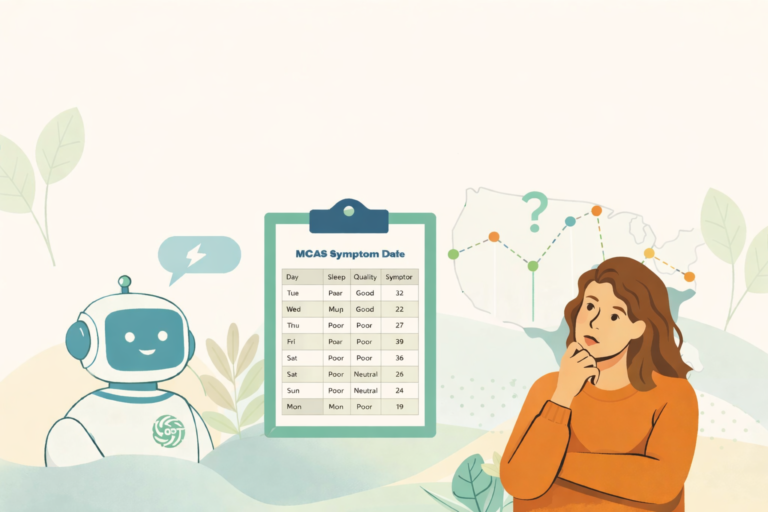
How ChatGPT Helped Me Identify MCAS (Not a diagnosis, a process)

Disclaimer: This post describes my personal experience using ChatGPT as a tool alongside medical care. It is not medical advice, and ChatGPT is not a diagnostic tool. Always consult qualified healthcare professionals for diagnosis and treatment.
For years, I knew something was off.
Randomly cold extremities. Days where I just didn’t have it on a run—when I knew I should have. Seasons where I kept getting “sick” when everyone else seemed fine.
Then things escalated.
I was “sick” every other week. Exhausted. Breaking out in random hives. Dealing with painful joints that didn’t make sense. I wasn’t sick in a dramatic, emergency-room kind of way—but in a slow, persistent something-is-wrong way. My body didn’t behave predictably. Symptoms came and went. Triggers felt inconsistent. Some days I could push hard physically; other days even mild exertion felt like moving through wet cement.
Doctors were kind. Tests were mostly normal. Advice was often reasonable—but fragmented. Each appointment focused on one piece of the puzzle: GI issues without the joint pain, exhaustion without the hives. Never the whole thing. That isn’t anyone’s fault—our medical system simply isn’t designed for diffuse, cross-system conditions with shifting presentations.
But living inside that reality is miserable.
The problem wasn’t just finding an answer. It was not knowing what was real—and not knowing what might be connected.
Looking back, even my childhood was full of strange symptoms: random pains, rashes, bug bites that swelled to the size of silver dollars. Some things clearly felt like symptoms. Others were harder to trust. When I always hit a wall in 5Ks—randomly stopping sweating, my legs locking up like charley horses—was that just poor training or mental weakness? (Years later, I’d learn those were symptoms of dysautonomia.) The off days, the seasonal struggles—were they physical, or was I just failing to push through?
And I couldn’t imagine how constipation, joint pain, hives, exhaustion, and cold, clammy skin could possibly be related to a single issue. They felt too unrelated. It seemed far more reasonable to hunt for multiple small explanations than one unifying cause.
That’s part of what makes mast cell disorders so difficult. Mast cells can release chemicals with wide-ranging effects across multiple biological systems—creating symptoms that look disconnected until you know what you’re looking at.
Bringing it together with ChatGPT
At first, I wasn’t trying to identify MCAS. I wasn’t even looking for a specific condition. I was desperate.
One night, alone in a hotel room after my kids were asleep, I brain-dumped every strange, unresolved symptom into ChatGPT. Earlier that day, I had listened to a podcast about a mother who used a chatbot to help identify a pattern of illness doctors had missed in her son. I figured I had nothing to lose.
ChatGPT did what computers have always done well: it found patterns in what looked like randomness.
It surfaced a throughline I hadn’t been able to see clearly on my own—mast cells. While ChatGPT is absolutely not a doctor and should never be treated as one, it gave me something critical: language. Terminology. A conceptual framework I could take seriously enough to pursue with actual doctors.
As the process continued, it also did something my exhausted brain couldn’t. It kept track of everything. It remembered prior constraints. It noticed inconsistencies I glossed over. It helped me slow down and separate what I knew from what I assumed.
It became a translator—turning dense medical language and lab results into something I could actually understand. I was still trusting what doctors were telling me, but I was also using ChatGPT as a kind of second opinion: looking for patterns across labs, symptoms, and timelines, and pressure-testing whether the story I was being told actually held together. I used that information to ask better questions, push for further testing, and build evidence for or against specific diagnoses.
It felt like having a whiteboard that didn’t erase itself overnight—a thinking assistant that helped me make sense of each step and clarify what the next one should be.
Narrowing the hypothesis space
For the first time, there was an explanation that didn’t require splitting my body into unrelated problems. It fit everything—the hives, the joint pain, the exhaustion, the cold skin, the GI issues, the exercise intolerance. More importantly, it was actionable. There were real things I could do: diet changes, lifestyle adjustments, medications that existed, specialists who actually worked in this space.
I didn’t take ChatGPT’s word as a diagnosis. But it gave me direction.
Diet was the most immediate example. I could ask very directly, “Can I eat ______?” and get a grounded explanation of why something was more or less likely to trigger a reaction—based on histamine content, freshness, preparation, and my past responses. It wasn’t certainty, but it was enough to help me make safer choices and understand why some foods consistently went wrong. That alone reduced a huge amount of day-to-day chaos.
And it didn’t stop at diet. It helped me understand what people actually do when they suspect MCAS—what changes are low risk, what tends to help, and what to bring to a doctor so I didn’t sound scattered or speculative.
As the summer went on, my symptoms didn’t stabilize—they escalated. Intermittent flares turned into something systemic. I was never not reacting. There was no baseline to return to, no reset button—just the growing realization that this wasn’t a small problem with a small fix.
A word of caution
This is so important, tools like ChatGPT are not medical authorities. They can amplify bad assumptions just as easily as good ones if you don’t stay grounded.
The value isn’t in asking, “What do I have?” It’s asking, “What patterns do I see, and what frameworks might explain them?”
Used responsibly, it can help you become a better historian of your own body—something clinicians deeply need but rarely have time to extract. It can help you recognize patterns and predict what those mean for your future. But it is critical to remember, ChatGPT makes mistakes, it loves to make things up, and go rouge. You have to be methodical, double check it it’s assumptions and treat it know different than any other opinion you receive.
Where I am now
ChatGPT continues toI help me ask better questions, pursue more targeted care, and stop gaslighting myself for symptoms that didn’t fit tidy boxes. ChatGPT has proven to me that insight can come from unexpected places—sometimes not from answers, but from structure. It is one valuable tool that has helped me organize, research and predict during a phase of my life that feels completely unpredictable and chaotic.