
MCAS and Doctors: One Person’s Journey Navigating the Challenge of Finding Support

It was dark in a hotel room in Florida, where I had just helped my two sons—nine and seven—fall asleep the night before we were due to fly back to Michigan.
We had flown south to spend a week in the warmth so my sons could enjoy being outside with my parents, who were snowbirding that winter. My wife, Meg, wasn’t able to join us on this impromptu trip, so once the kids were asleep, I had a rare moment of quiet to myself.
I had spent the week loving the chance to be outside, to get some decent runs in, and—most importantly—to feel healthy. That last part lingered in my mind, because I knew, just like every summer for the past few years, the upcoming summer would likely bring another stretch of unexplained symptoms.
The night before, I had listened to a podcast about a mother who had spent years trying to get answers for her special-needs son’s medical struggles. Out of desperation, she used ChatGPT not as a doctor, but as a way to look at all of her son’s symptoms together—to see if patterns might emerge that siloed care had missed. Much to her surprise ChatGPT was able to make meaningful suggestions that with the help of an open-minded physician, eventually changed her son’s quality of life. ChatGPT wasn’t a doctor, but it did do what computers have always been great at, pattern recognition.
I sheepishly created my login, started a new conversation, and began typing. I wrote for a good thirty minutes. I put everything down—no matter how strange or unrelated it seemed, even including the fact that as a kid, my mosquito bites would swell to the size of a silver dollar.
When I finally hit enter, I watched the dots dance on the screen, fully expecting a cautious response along the lines of: “I am not a doctor, and this sounds like a collection of unrelated symptoms likely caused by several minor conditions.”
Instead, ChatGPT’s response was clear, concise, and unsettlingly direct: Mast Cell Activation Syndrome.
It wasn’t a diagnosis nor a treatment, but it was a name that seemed to fairly define and explain growing progressively worse for years. This starting point sent me into a long, confusing process of trying to find care within a medical system that often isn’t built for conditions like this.
It would take me months to understand how difficult Mast Cell Activation Syndrome (MCAS) can be to diagnose and treat. That MCAS doesn’t live neatly in one medical specialty. It can affect the skin, gut, nervous system, joints, energy levels, and more—all without clean lab results or textbook presentations. It would take a variety of experiences to learn that many providers are trained to recognize only its most obvious or acute forms. A gap that isn’t usually anyone’s fault, but it matters deeply for patients trying to find answers and trying to figure out how to function day to day.
What follows isn’t a critique of individual doctors. It’s a map of the kinds of care I encountered—and what each could and couldn’t offer. If you’re newly diagnosed, undiagnosed but suspicious, or supporting someone with MCAS, I hope my account of the types of care I have encountered helps you feel more prepared to navigate the challenge of getting help with this condition.

Six Types of Care You’re Likely to Encounter When Navigating MCAS
As I’ve tried to get to the bottom of my symptoms, I’ve encountered a wide spectrum of reactions from medical providers. While some interactions were much more valuable than others, none of them were useless nor were they the result of incompetent providers — just different constraints, different mental models, and different limits.
1. Belief Without Specialization
From what I have read (and from what my experience backs up) is that doctors tend to believe you when you say you are experiencing a symptom (agreeing on the cause and treatment is a different challenge). Doctors in this category are the providers who believe you. They listen. They validate that something real is happening, but they do not feel comfortable treating you beyond a certain point.
For many people, this is the first moment of relief after months or years of doubt. For me, this was my experience with my primary care provider. When I reached out to her about the possibility of MCAS, she was very open about exploring it, but did not have expertise (nor the time I am sure!) to do so herself, that is what specialists are for after all!.
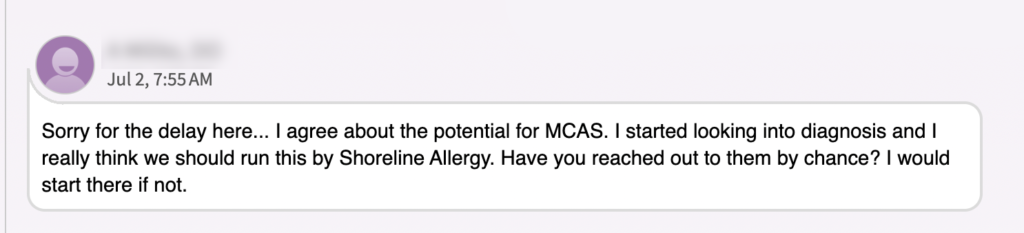
The truth is MCAS is complex, and primary care doctors rarely have the training or tools to diagnose or manage it fully. Their role is often to acknowledge the problem and refer you onward.
Strength: Trust, openness, emotional safety. Ability to open doors to basic testing and specialists who can take you to the next step in your care journey.
What to know: This kind of care matters—but it can’t carry the whole load for you. Make sure to push for the resources you need to get the answers you deserve. Come in with a plan and your evidence, push for testing to help with your specialist visits.
2. Outdated Understanding
If you are lucky, your next step will be to meet with a specialist with a modern understanding of MCAS. If you are not so lucky, you will meet with the sub-section of specialists who understand MCAS only as a rare, episodic condition—something that appears as occasional dramatic flares, not a chronic, systemic problem. This is a Traditional Allergy Model understanding of MCAS. When symptoms don’t match that traditional model, they may be minimized or dismissed by these providers.
This isn’t usually malicious. It’s often the result of older training and slow-moving updates to clinical practice, but it can leave patients feeling unseen and stuck. It is common that these providers will have a limit of how far they are willing to explore diagnosing your condition and will stick to over-the-counter treatments. While OTC medications will likely play an important role in your overall treatment solution, it will only be a part of it. Getting the support of additional providers who will be willing to help you get access to additional resources, such as Mast Cell Stabilizers or LDN can make a big difference.
Strength: Clear protocols for classic allergy conditions. Typically they will treat the symptoms which can bring some relief, for example getting MCAS patients started on H1/H2 anti-histamines.
What to know: You may be speaking different languages without realizing it and these doctors are never going to support you through getting access to harder to get treatments like mast cell stabilizers or help you with meaningful lifestyle changes.
3. Lack of Urgency
All medical care providers are overworked, it is just a sad truth of the system we have to work with. Unfortunately, MCAS doesn’t wait politely. Symptoms can escalate quickly, and quality of life can deteriorate fast while we wait for our system to move on fixed timelines—routine appointments, annual check-ins, and long referral waits.
Being told to “wait and see” can be devastating when your body is actively destabilizing. This is especially difficult early in your MCAS journey when you know how you feel, but don’t have the terminology to describe what you are facing to a medical professional in a way that accurately conveys the need for urgency.
Strength: Orderly, safe, standardized care.
What to know: Time (and therefore your suffering) matters more than systems often acknowledge. It is ok to seek second opinions and to try to make changes that are safely within your control (diet, stress management, over the counter medications, etc)
4. Understanding, With a Ceiling
Some providers genuinely understand MCAS. They’ve read the research. They attend conferences. They believe you and appointments feel collaborative instead of adversarial.
But even here, there can be limits—institutional policies, personal risk tolerance, or discomfort prescribing less common medications. When first-line treatments fail, progress may stall. For me this looked like conversations with providers where they literally said “this is as far as we are willing to take treatment, anything else is going to have to come from another professional” (I like to coin that professional as a more “specialistly specialist”).
This is an incredibly frustrating situation to be in where everyone in the room knows what the logical next step is, but policy or risk tolerances prevents that critical next step from being accessible. If/when you reach this wall, ask questions, learn about what that next step is and then find someone (the mythical more “specialistly specialist”) who will be willing to explore it with you.
Strength: Validation, expertise, real attempts at treatment and access to new lines of testing and treatment you would not have otherwise received.
What to know: That any step in the right direction, even if it eventually comes to a dead end, is still so valuable for your own understanding and comfort. Each positive interaction you can have along the way is just more understanding you can bring to the next provider you interact with.
5. Pattern Recognition Without Care (AI ChatBots)
AI tools aren’t doctors. They can’t diagnose or treat. But they can be helpful in a different way: surfacing patterns, synthesizing information, and highlighting things you might otherwise miss.
For me, AI became my pattern recognition tool (something computers have always been great at) and my medical translation tool. For example I ran all of my lab results through ChatGPT, summarized all of my doctor visits to the chat bot and explored possible treatment options. One early win I had with this approach was that ChatGPT was able to compare my historical lab results to a recent round conducted by my primary care provider and discovered that there was a rise in tryptase levels that met the “20% + 2” rule—an indicator of MCAS I would have overlooked on my own and providers were unlikely to catch.
Using AI tools comes with real privacy trade-offs, and those risks shouldn’t be minimized. Everyone has to weigh them for themselves.
Strength: Pattern recognition, synthesis, education and finding additional resources.
What to know: This is a tool, not a provider, but AI can help you get the most out of the care you are receiving by helping you to decode what doctors are saying, what your test results are and for helping you to identify new avenues for care to pursue.
6. Access Without Support
Some physicians are willing to prescribe medications others won’t—often remotely and often out of pocket. This can open doors when local care stalls. They can give you access to hard to get Mast Cell Stabilizers and LDN.
But it can also be isolating. You may have access without continuity, medications without guidance, and decisions without a safety net. These are “choose your own adventure” providers who are willing to support your journey of finding a medication regime that works best for you, but you will be doing the heavy lifting of trying different dosages and combinations.
These medications can make a difference, but keep in mind they are rarely a complete solution to MCAS symptoms. MCAS requires a multi-faceted treatment approach that includes medication, diet, environmental controls, stress management and more.
Strength: These providers are often flexible and easy to access to otherwise hard to get medications.
What to know: This can be a lifeline—but it’s rarely sufficient on its own. Make sure you have done your homework before you go down this road and have an idea of what you want to try first. Take your time and track your symptoms closely as you try different medications.
Now That You Know
If you’re navigating MCAS, my biggest takeaway isn’t to follow a specific path—it’s to understand the landscape.
Most people end up using a mix of these six types of care. The balance that works for you may not look like mine. What matters is knowing where each type helps, where it doesn’t, and why frustration so often isn’t personal.
Read. Learn the language. Advocate for yourself without assuming bad intent. And if navigating all of this feels overwhelming, that’s not a personal failure—it’s a reflection of how fragmented care often is for conditions like MCAS.
This isn’t medical advice. It’s one person’s lived experience inside a system that often struggles to meet patients where they are. I hope it helps and if I can ever help – feel free to reach out. It can get better.