
Mast Cell Activation Syndrome – My Origin Story

My name is Craig, and eight years ago, during the heat of summer, my legs suddenly went cold. Even in the middle of long runs — fifteen miles or more, drenched in sweat — they wouldn’t warm up. That was the beginning of something I couldn’t explain. Even though I didn’t know it at the time, it was my first encounter with Mast Cell Activation Syndrome (MCAS).
Each summer after that brought new mysteries: breaking out in hives after swimming, strange rashes, swelling, endless “colds,” and a growing list of odd reactions my doctors couldn’t connect. Four years ago, an allergist diagnosed me with chronic urticaria, and admitted the diagnosis didn’t quite fit.
From there, things got worse. By the summer of 2024, I was “sick” every other week. My skin would swell and go cold. My joints ached, my energy vanished, and for the first time since middle school, I couldn’t run. Each time I tried, my joints would seize up, my skin would burn and I would break out in hives. When fall came and my symptoms eased, I realized something about summer itself was making me ill.
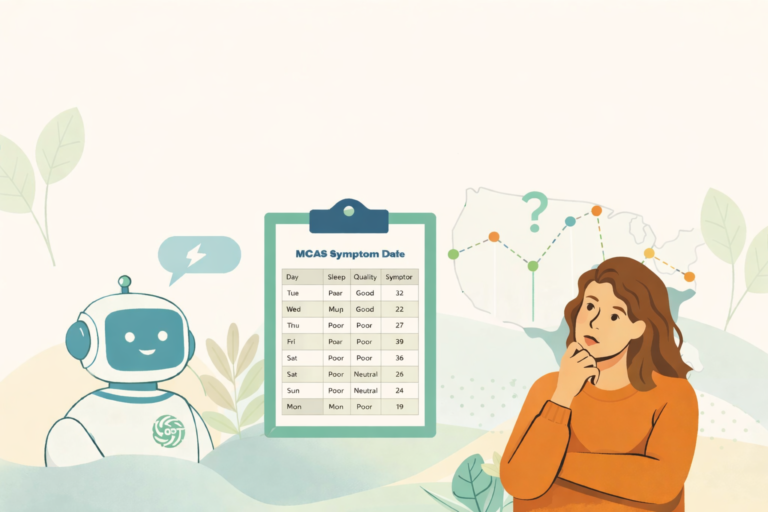
Then, over my kids’ winter break, I heard a podcast about someone who had used ChatGPT, not as a doctor, but as a tool to see patterns in scattered medical notes. Out of curiosity (and desperation), I tried the same. I spent thirty minutes listing every symptom I could remember from the past decade and hit enter.
Its answer changed my life: Mast Cell Activation Syndrome.
For the first time, everything made sense. I shared it with my primary care doctor, who agreed it was worth pursuing. I dove headfirst into treatments, low-histamine diets, and every resource I could find. I was determined that summer 2025 would be different, I felt so confident that I even signed up for one of my bucket-list marathons.
I couldn’t have been more wrong.
By May, I tanked. Hard. I couldn’t eat, walk, or think clearly. My skin burned, my joints locked, my back stiffened, and my energy flatlined. Life became a fog of pain and fatigue.
Then we went on vacation.
We flew to Reno, Nevada to settle my wife’s late aunt’s affairs, then rented an RV to explore the northern California coast and redwoods. The kids were wild, the trip was absolutely chaotic and emotionally challenging, but one morning in the camper, I woke up and told my wife, “I feel great.” It was gone. The pain, the fatigue, the stiffness, not completely gone, but so much better.
A week later, back home in Michigan, it all returned. That seven-day window changed everything. It showed us that environment was a missing piece of my treatment — not just medication, diet, or lifestyle.
Digging into this idea more, I learned about the concept of an MCAS bucket, how many small triggers (pollen, weather shifts, mold, food, stress) can fill the bucket until it overflows into a flare. The more triggers, the faster it spills. It explained everything: why summer wrecked me, why the dry, mild air of Reno and coastal California gave me relief.
When I shared our plan to sell our home and travel the country to find a place where I could live with less pain, no doctor laughed. They nodded. They understood. Some even encouraged it.
So here we are. We are preparing to sell our home, pack up our lives into a 32-foot trailer, homeschool our kids, and travel coast to coast in search of what we call “Base Three” (our third home, and hopefully the right one).
We don’t know what we’ll find. But we’re ready to look.
If our story helps you ask new questions, see patterns you hadn’t noticed, or simply feel less alone, then it’s already worth it.
Thanks for reading,
Craig




Hi Craig, thank you for sharing your incredibly personal journey with MCAS. Your story about environmental triggers and the “MCAS bucket” concept really resonated with me. I’m curious—have you or your doctors ever explored peptide therapy as part of your treatment plan?
I recently came across an interesting article discussing BPC-157 and KPV peptides for MCAS management (https://mindbodyneurology.com/bpc-157-and-kpv_peptides-for-mcas/) that might offer some additional insights, particularly regarding gut healing and inflammation modulation. Since you’ve had such success with environmental changes, I wonder if these might complement your current approach?
Wishing you all the best in your search for “Base Three”—your family’s dedication is truly inspiring.
Thanks so much for the thoughtful comment — and for reading closely enough to notice the environmental thread. That really has been the biggest factor for me.
Peptides have come up in my research and they have been suggested by others I have spoken with, however I’ve chosen not to pursue them so far. With MCAS, I’ve found that time, money, energy, and emotional bandwidth are all limited resources, and I’ve had to be pretty intentional about where I invest them. For me, the strongest evidence, and the most consistent improvement, has come from reducing my environmental load.
That said, MCAS is incredibly individualized. What moves the needle for one person may do very little for another. My triggers skew heavily environmental, while for others food, GI, or medications play a much larger role.
I really appreciate you engaging so thoughtfully, and I hope you’re able to find the mix of approaches that works best for you!