
Why MCAS Symptoms Change Every Day: The Bucket Theory Explained

If you have MCAS you’ve probably experienced something similar to:
Yesterday you went for a run and felt fine.
Today you ran the same route and ended up covered in hives.
It can feel completely random.
While there is no perfect way to explain why an individual reaction occurs on one particular day, one mental model has helped me make much more sense of my symptoms. I call it the Bucket Model.
The Bucket Model
Imagine your body’s ability to tolerate triggers as a bucket and every trigger you encounter adds water to your bucket, filling it up. As long as your bucket is not full, your body may tolerate those combined exposures without producing noticeable symptoms—or without producing symptoms severe enough to stop you from doing what you are doing.
There are so many potential triggers, and the relevant triggers can vary substantially between individuals and even change over time (PMC). Depending on your personal flavor of MCAS your triggers might include: mold, pollen, dust, heat or cold, exercise and stress, certain foods, infections and other environmental factors. This means that everyone’s bucket fills at different rates at different times.
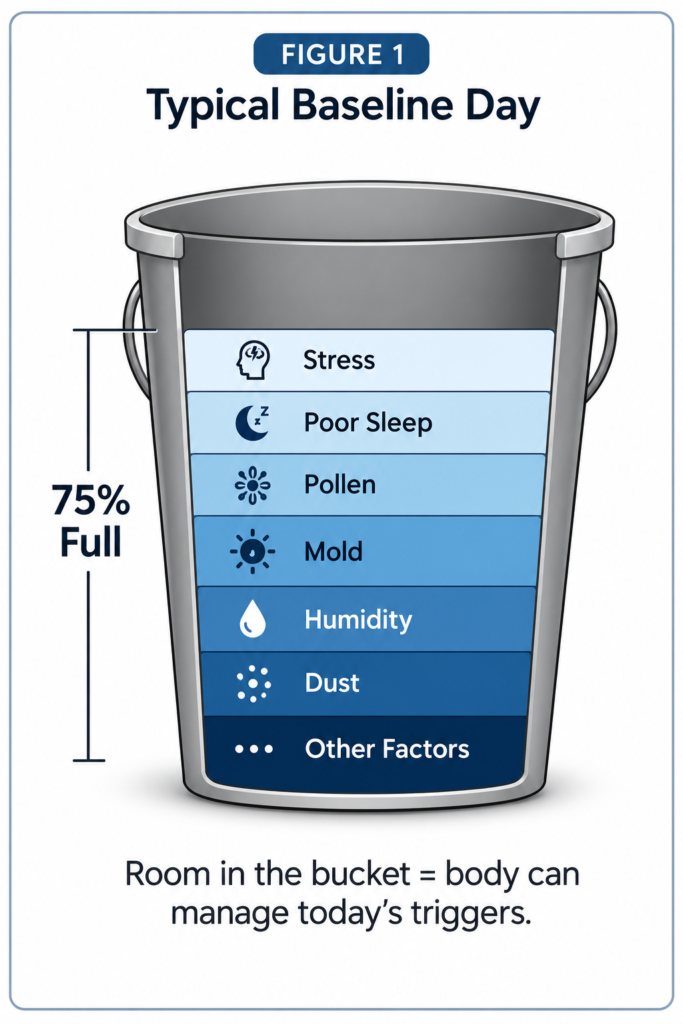
Notice that the bucket is not empty in our baseline figure above.
None of us begins the day with no environmental exposures, physical stressors, illnesses, emotional stress, or other influences. So the question is always ”how much space is left in my bucket before it overflows and symptoms appear?” and not “is the bucket completely empty?”.
Suppose your bucket is about 75% full at baseline as shown in the figure above.
On a day where you are just dealing with your baseline fullness, you may find that you can tolerate activities that concern you on other days. Maybe on this day you decide to, go for a strenuous run and/or eat some leftovers that you suspect are higher in histamine. Each adds a little more to the bucket, lets say around 10%.
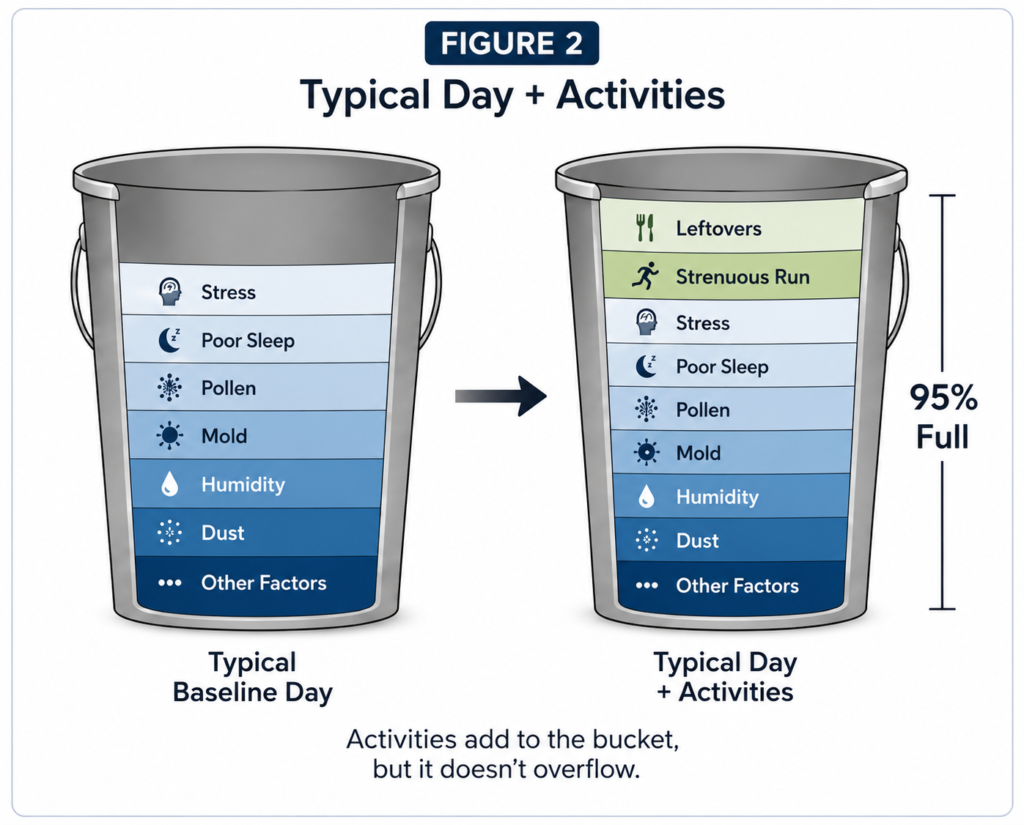
Even after doing both, you might not experience a significant reaction because the bucket never quite reaches the top.
So far, so good.
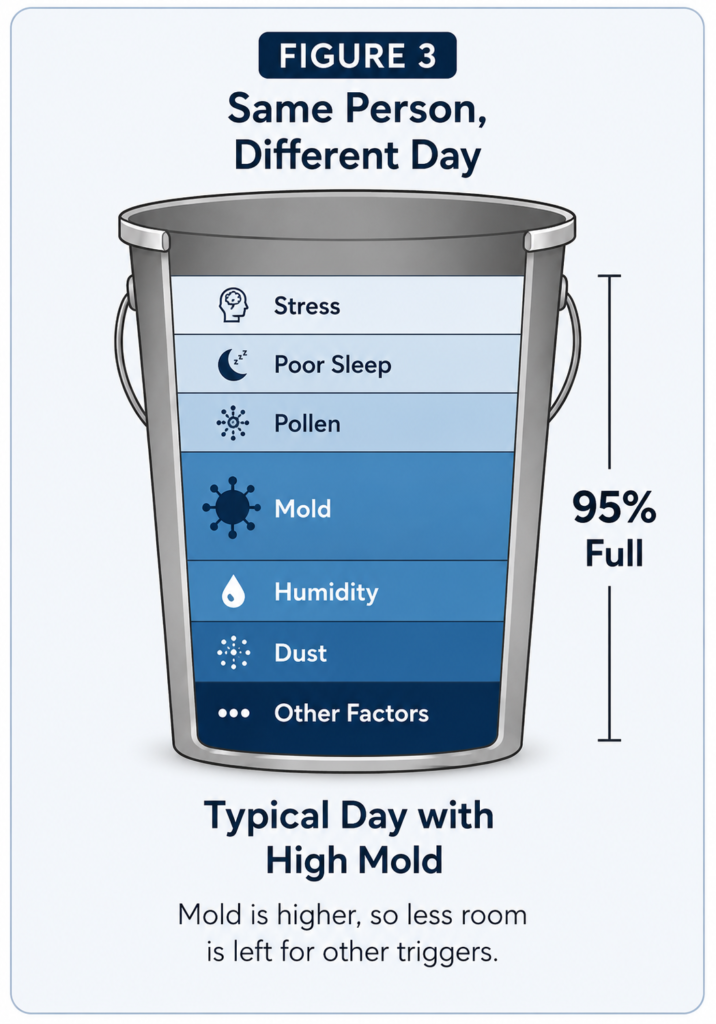
Now imagine something else changes. Suppose it has been an unusually wet spring and mold exposure around your home appears to be much higher than usual.
Nothing obvious about you has changed.
You are eating similar foods, running similar routes, and following approximately the same routine. But one potential environmental contributor has quietly become much larger.
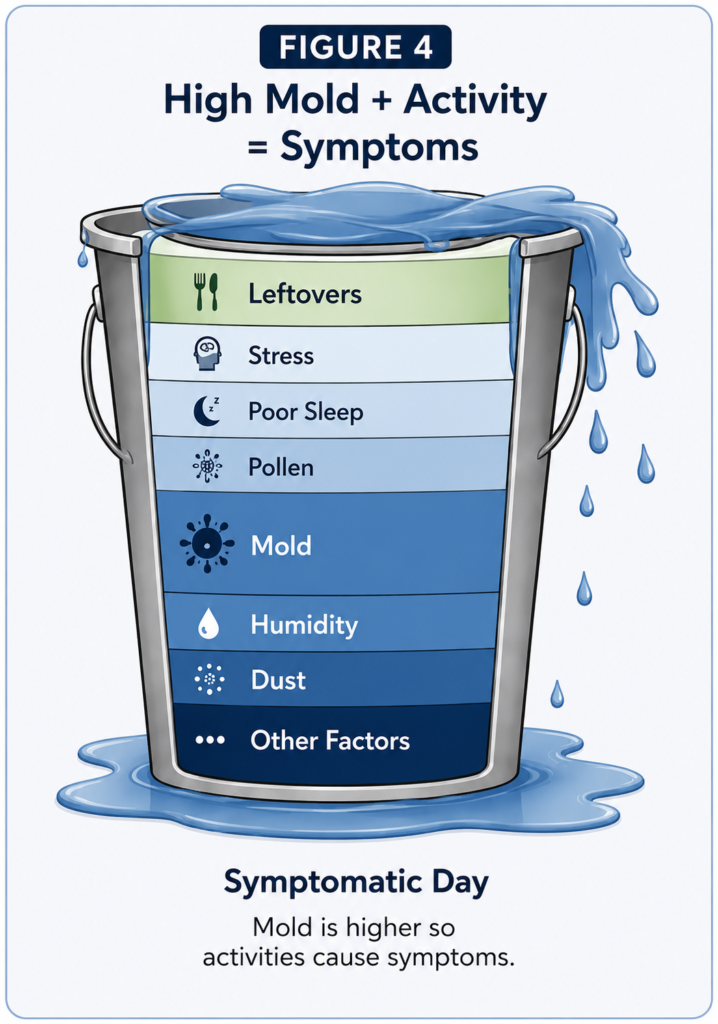
Now you are beginning the day with very little room left and this is where the bucket model becomes useful to understanding how running or leftovers could feel like they have suddenly become a problem. This is because if you are already at a 95% full bucket it doesn’t take much to suddenly find yourself battling MCAS symptoms.
In this new scenario either the strenuous run OR the high-histamine leftovers would cause your bucket to overflow and symptoms to begin.
The mistake I often made was assuming that the last thing I did must also have created the entire problem. For example If I developed hives while running, I blamed the run or If I reacted after eating leftovers, I blamed the food.
Sometimes the final activity may genuinely be an important trigger. But it may also be only the final addition to a much larger combination of factors. That distinction matters because eliminating only the last thing may not address the conditions that left so little room in the bucket to begin with.
Everyone’s Bucket Is Different
In addition to having different triggers, no two people with MCAS necessarily have the same bucket. Some people have very large buckets, others very small.
This means people will also differ in how much combined exposure they tolerate before symptoms appear. The broad range of possible symptoms and triggers is one reason that evaluation and treatment of MCAS must be individualized. (JACI Online)
This means while the model of the bucket stays the same, each person experiences: 1) What fills their bucket, 2) How much each factor contributes to their bucket., 3)How big their bucket is and 4) How quickly their empties again after it overflows, differently.
Using the Bucket Model to Manage Symptoms
We can use this model to help us understand how to manage our MCAS symptoms as well by focusing on two mitigation strategies:
Ideally, you work on both—with the help of a qualified healthcare professional where medical treatment is involved.
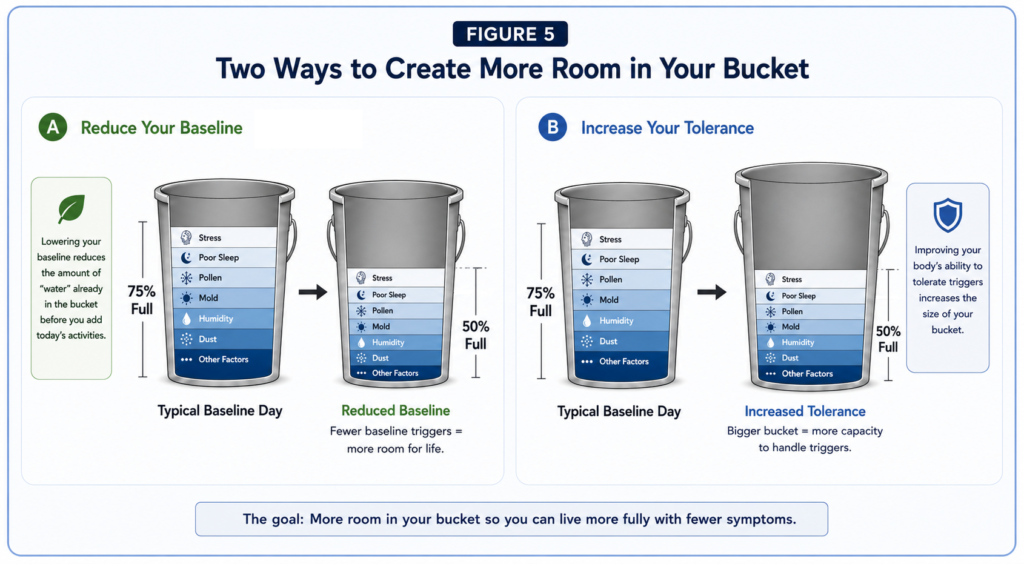
A. Reduce Your Baseline
Reducing your baseline means decreasing some of the potential contributors that are already present before you add the day’s activities. This can be difficult because many exposures are not fully within our control.
If pollen is an important trigger for you, practical exposure-reduction measures might include keeping windows closed, using filtration, changing clothes or showering after prolonged outdoor exposure, wearing a well-fitting mask during high-exposure activities, or adjusting outdoor plans according to conditions.
None of these removes pollen from the world. Each may only take a small amount out of the bucket, which can feel very frustrating, like trying to bail out a sinking ship with a spoon. However several of these small reductions together may leave more room for the things you actually want to do.
For me, reducing my environmental baseline became the motivation behind our family’s year-long 7,500mi journey around the country to see if we can find locations where my environmental triggers are lower. If I can identify environments where my baseline is naturally lower, I will have more room to run, hike, spend time outside, and live normally again.
Diet and the baseline
This topic deserves more attention than I can give it here, but is so important to so many people struggling with MCAS that it needs to at least be mentioned
Diet may be another modifiable factor for some people, but this subject needs so much nuance.
Research on low-histamine diets primarily concerns histamine intolerance, which is related to but not synonymous with MCAS. Published reviews have also found substantial disagreement over which foods should be restricted, and controlled research remains limited. A placebo-controlled challenge study found that many people who believed they had histamine intolerance did not react specifically to histamine during testing. (PubMed)
That does not mean food cannot matter. It means extremely restrictive diets should not automatically be treated as necessary for everyone with MCAS.
A more measured approach is to identify foods that repeatedly correspond with symptoms, evaluate the pattern carefully, and consider working with a knowledgeable physician or registered dietitian—particularly before removing large categories of food. For me, that looks like avoiding heavily processed foods, some dairy and tomato products.
B. Increase the Size of Your Bucket
The second strategy is to improve your ability to tolerate the triggers that remain. This is most often accomplished through the use of different medications, most commonly H1 and H2 antihistamines, LDNs, mast-cell stabilizers and epinephrine for emergencies (PubMed) (PubMed)
Non-medication factors may also influence how well someone feels or functions, including:
- Consistent sleep
- Adequate hydration
- Appropriate nutrition
- Managing other health conditions
- Avoiding repeated exposure to established triggers
- Gradually rebuilding conditioning when tolerated
- Managing stress where realistically possible
I would be cautious about describing these as ways to directly “stabilize mast cells” unless evidence supports that specific claim. A better way to think about them is that overall health, recovery, and treatment of contributing conditions may affect how much strain your body can manage.
Some people also explore supplements or alternative treatments. Individual experiences vary, but many supplements marketed for MCAS have not been tested in rigorous clinical trials specifically for MCAS. “Natural” also does not guarantee that a product is effective, safe, or free of interactions. I personally choose to mostly avoid this option.
Tracking Helps Reveal What Is in the Bucket
The Bucket Model cannot tell you which trigger caused a particular reaction, but what iit can do is provide a reason to look beyond the most recent exposure and examine the broader context.
That is why I track not only symptoms but also factors such as:
- Sleep
- Pollen
- Air quality
- Weather
- Time outdoors
- Activity
- Location
- Visible exposures
- Other changes in my routine
A single entry rarely tells me much, however repeated patterns over weeks or months are much more useful.
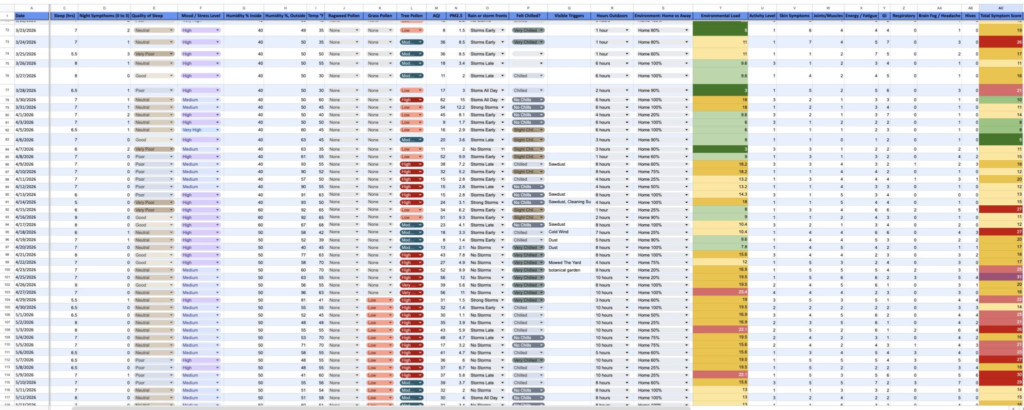
Tracking cannot remove every uncertainty, but it can help identify questions worth investigating and make it easier to discuss those patterns with a healthcare professional. If you’d like to learn more about my approach to tracking you can find my post about it here.
Remember – The Goal Is Not an Empty Bucket
It is not possible to live a life without triggers. Instead, the goal is to create enough room in your bucket that you can live again.
That means lowering your baseline where you realistically can.
It means working with doctors to improve symptom control.
It means continuing to track patterns without assuming that every correlation proves a cause.
And perhaps most importantly, it means remembering that one bad day does not erase the progress you have made.
Every pattern you identify, every exposure you learn to manage, and every change that gives you a little more room is another step toward rebuilding the life you want.
That is why I track my symptoms. That is why my family and I are traveling the country looking for a healthier environment.
And that is why I hope this simple model helps make your own experience feel a little less random.
Medical Disclaimer
This article describes a mental model that I use to understand my personal experience with MCAS. The Bucket Model is not a validated medical or diagnostic model, and this article is not medical advice. MCAS can involve serious reactions, including anaphylaxis. Discuss diagnosis, treatment, dietary changes, supplements, and emergency planning with a qualified healthcare professional.
Suggested references
Castells M, Butterfield J. Mast cell activation syndrome: Current understanding and research needs. Journal of Allergy and Clinical Immunology, 2024. (JACI Online)
Weiler CR et al. AAAAI Mast Cell Disorders Committee Work Group Report: MCAS diagnosis and management. Journal of Allergy and Clinical Immunology, 2019. (JACI Online)
Castells M, Butterfield J. Mast Cell Activation Syndrome and Mastocytosis. Clinical Reviews in Allergy & Immunology, 2019. (PubMed)
Nurmatov UB et al. H1-antihistamines for primary mast cell activation syndromes: a systematic review. Allergy, 2015. (PubMed)
Kulinski JM et al. Elevation in histamine and tryptase following exercise in patients with indolent systemic mastocytosis. 2018. (PMC)
Sánchez-Pérez S et al. Low-Histamine Diets: Is the Exclusion of Foods Justified by Their Histamine Content? Nutrients, 2021. (PubMed)






What a fascinating and thorough way to look at MCAS symptoms. I’m glad you’ve found a way to help navigate symptoms, and that you are sharing what you’ve learned with others.
I’m enjoying all of the updates from your year-long adventure!